Most people assume a water heater has an easy summer. The incoming water is warmer, so the tank has less work to do. That’s true as far as it goes, and it’s also why so many Tucson water heaters fail in July rather than January.
Summer isn’t easier on a water heater here. It’s the hardest stretch of the year, for reasons that have more to do with where the tank sits and what’s in our water than with how much hot water you’re using.
Where Your Tank Lives Matters More Than You’d Think
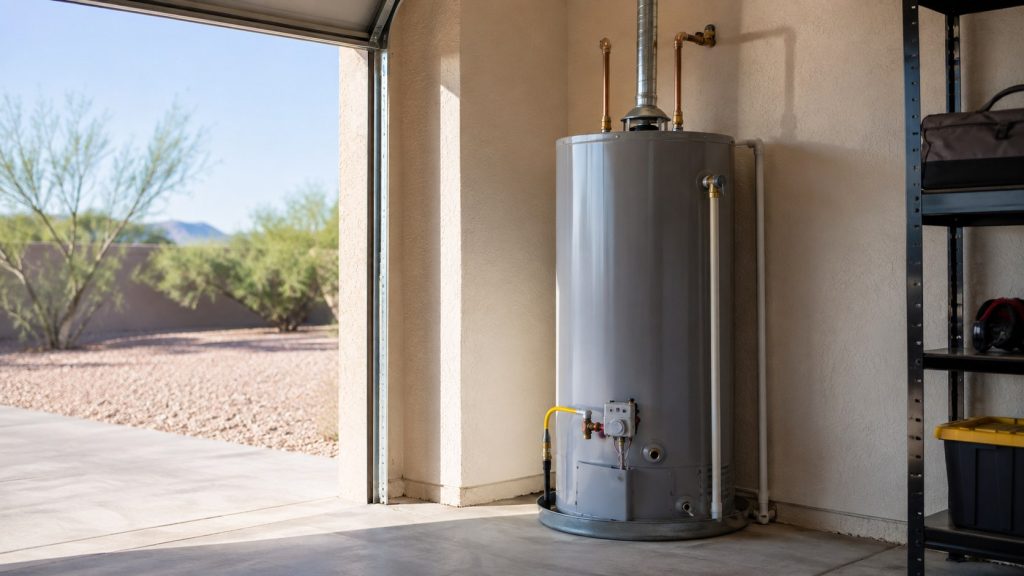
In Tucson, water heaters usually end up in a garage, a utility closet against an exterior wall, or occasionally an attic. All three are the hottest parts of the house from June through September.
A garage without conditioned air routinely runs well above outdoor temperature during the afternoon, because the concrete slab and the roof hold heat and release it slowly. An attic is worse. The tank’s job is to hold water at a set temperature, and every component in it, including the thermostat, the gas control valve, the anode rod, and the tank lining, is working in that ambient heat all day long.
Heat accelerates corrosion. It also stresses the electronics and gas controls that regulate the unit. A tank that would last comfortably in a Midwest basement is simply living a harder life here.
What Hard Water Does Inside the Tank
Tucson water carries a significant mineral load. When that water is heated, dissolved calcium and magnesium come out of solution and settle on the bottom of the tank as sediment.
That layer of sediment causes three separate problems.
- It insulates the burner from the water. On a gas unit, the flame has to heat through a crust of mineral before it reaches water, so the unit burns longer to hit the same temperature. Your gas bill notices before you do.
- It creates hot spots. Uneven heating stresses the tank lining, and the lining is what stands between the water and bare steel.
- It makes noise. That popping or rumbling you hear is water flashing to steam underneath the sediment layer and forcing its way out.
Sediment builds up in any water heater. It builds up faster here, and heat speeds up the chemistry that puts it there.
Signs Your Water Heater Is Struggling
A water heater usually gives you a season of warning before it quits. These are the signals worth acting on.
- Rumbling, popping, or crackling during a heating cycle. That’s sediment, and it means the tank is working harder than it should.
- Hot water that runs out faster than it used to. Sediment takes up volume that used to hold water.
- Rusty or discolored hot water. If it’s only on the hot side, the problem is inside the tank.
- Moisture, rust, or mineral crust around the base. A tank that’s weeping is a tank that’s going to fail, and the only question is when.
- Water at the discharge pipe from the relief valve. Sometimes it’s a failing valve. Sometimes it’s pressure that shouldn’t be there. Either way it needs to be looked at.
A leak at the base is the one that isn’t a wait-and-see item. Once the tank itself is compromised, there’s no repair, and a fifty-gallon tank in a garage or an attic can do real damage on its way out.
Maintenance That Actually Extends the Life of a Tank
Two things make the biggest difference in Tucson, and neither is complicated.
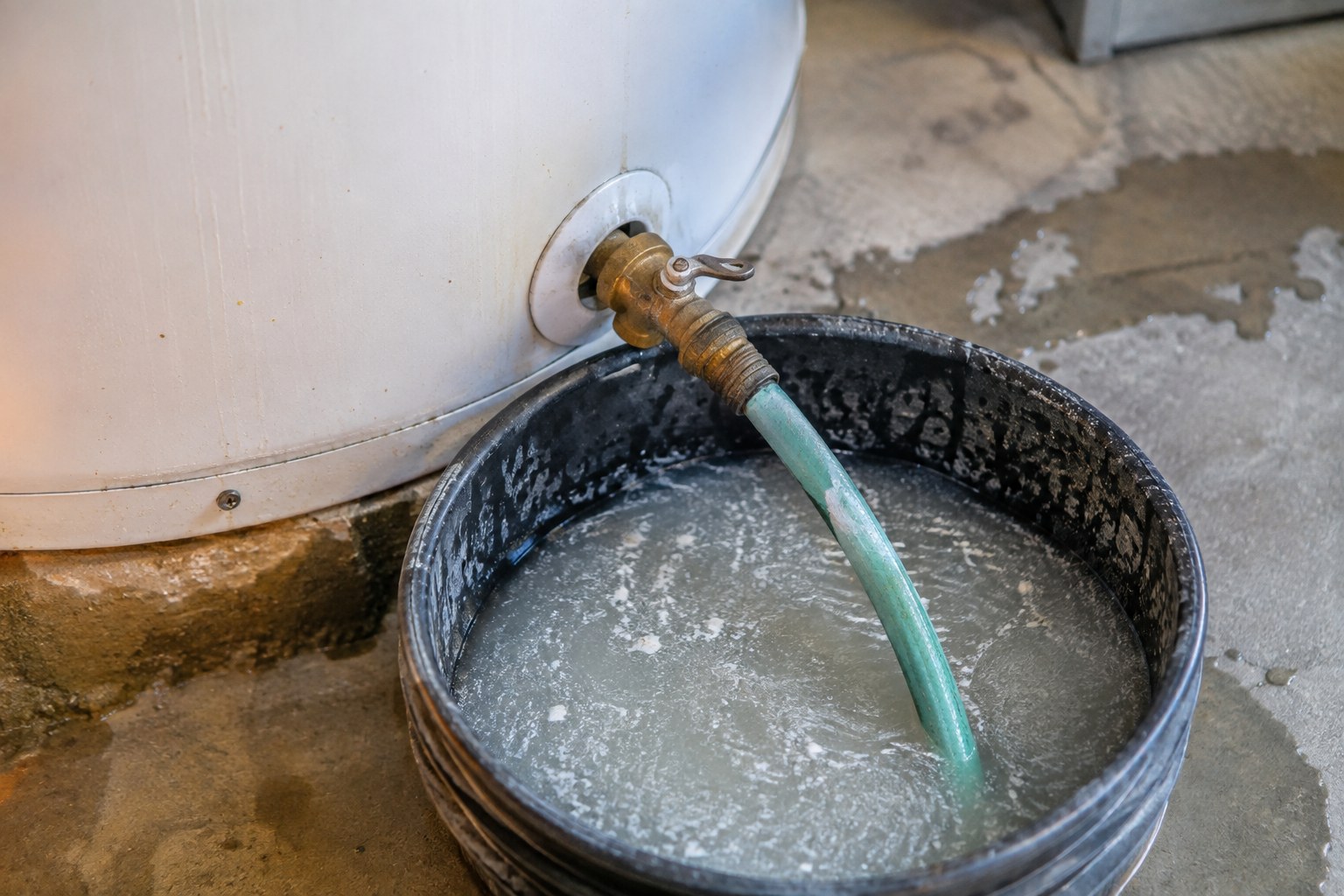
The first is an annual flush. Draining the sediment out before it builds into a thick layer keeps the burner efficient and takes stress off the lining. If your tank has never been flushed and it’s more than a few years old, have a professional do the first one, because a heavy sediment layer can clog the drain valve and turn a simple job into a mess.
The second is the anode rod. It’s a sacrificial metal rod inside the tank that corrodes so the tank doesn’t. In hard water it depletes faster. Replacing it on schedule is one of the least expensive things you can do to add years to a water heater, and it’s routinely ignored because most homeowners have never heard of it.
If hard water is causing problems across the whole house, and in Tucson it usually is, water softening and filtration addresses the cause rather than the symptom. Your water heater isn’t the only appliance paying the mineral tax.
Repair or Replace?
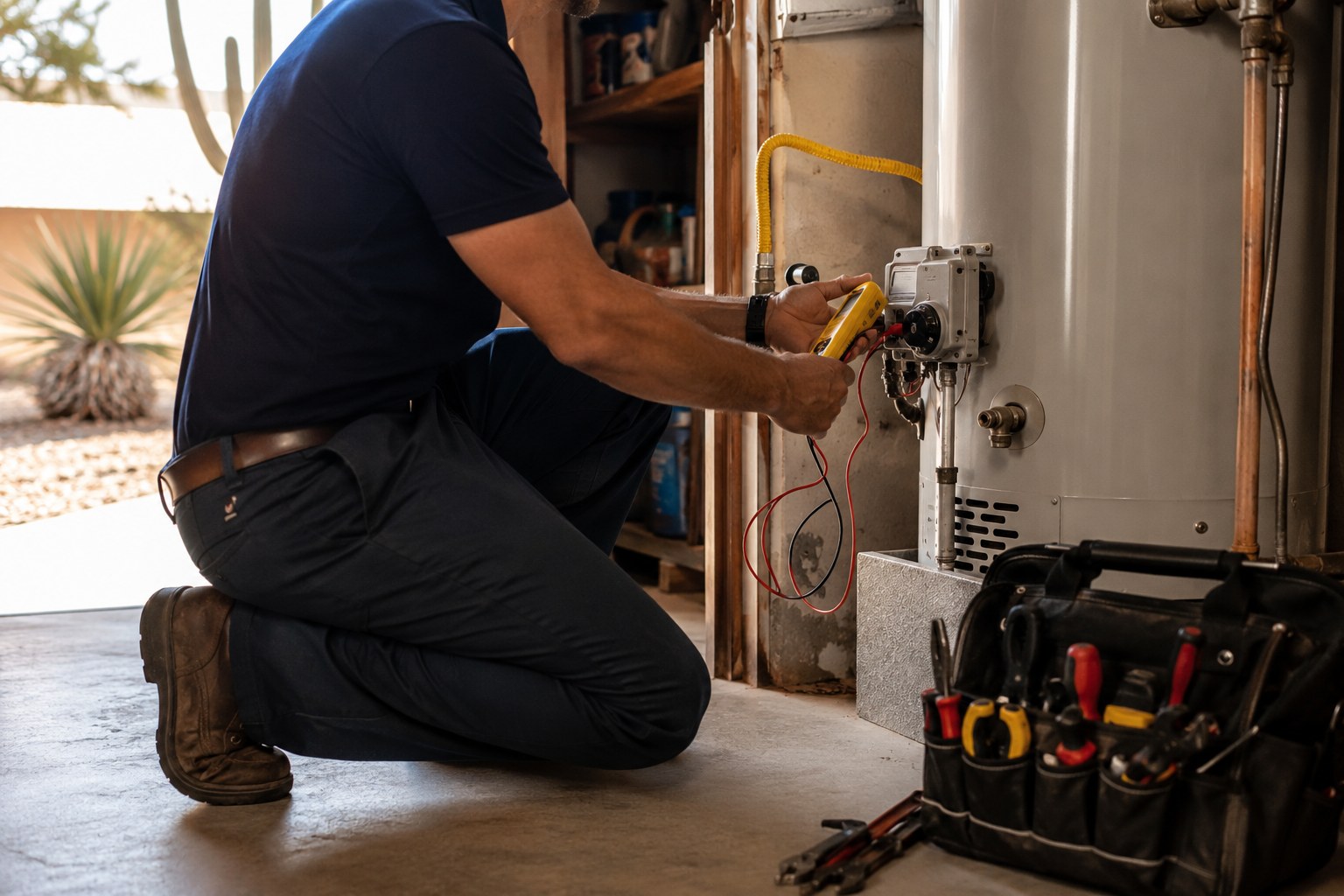
This is the question we get most often, and the honest answer depends on three things: the age of the unit, what’s failed, and whether the tank itself is sound.
Thermostats, heating elements, gas control valves, and relief valves are all repairable, and on a unit that’s still in the earlier part of its life, repair is usually the right call. A tank that’s leaking from the body is a replacement, regardless of age.
The grey area is a unit that’s aging and has started needing repairs. At that point you’re weighing the cost of keeping it running against the efficiency and reliability of a new one. We’ll give you the numbers for both and let you decide. If replacement is the direction, financing is available, and our water heater installation and repair service covers both directions.
Common Questions About Water Heaters in Tucson
How long should a water heater last here?
Manufacturer estimates assume typical conditions. Tucson’s heat and hard water tend to shorten real-world life, and units that have never been flushed fall further short. Maintenance is the single biggest variable.
Can I flush the tank myself?
If it’s been flushed regularly, yes. If it hasn’t been flushed in years, have it done professionally the first time. A drain valve that clogs mid-flush on a full tank is a problem you don’t want on a Saturday.
Does turning the temperature down help?
Lower temperatures reduce mineral precipitation and energy use. Going too low creates its own concerns, so it’s worth discussing the right setting for your household rather than guessing.
My water heater is in the attic. Should I be worried?
Attic installations need a properly installed and properly drained overflow pan. If yours doesn’t have one, or the pan drains to nowhere, that’s worth correcting before the tank ever gives you trouble.
Would a tankless unit hold up better?
Tankless units avoid the sediment-in-the-tank problem, but hard water still scales the heat exchanger, so they need descaling and generally want pretreatment here. We’ll walk through the tradeoffs honestly rather than pushing one direction.
Give Us A Call Today!
If your water heater has been noisy, or the hot water doesn’t last the way it used to, summer is the right time to look at it rather than the wrong time to find out. A flush and an inspection cost a fraction of an emergency replacement.
Call PlumbZona at (520) 392-4862 or schedule a visit online. Ask about our membership program if you’d like annual maintenance handled without having to remember it.